SHOPPING BAG
Pumpkin Spice Coffee: From Autumn Trend to Seasonal Experience

Every day, across thousands of hospitality and foodservice businesses, coffee is served almost continuously. Along with it comes something that rarely takes center stage in the conversation: the waste left behind after every cup.
Used coffee grounds, empty capsules, packaging, and the materials associated with daily coffee consumption are all part of a process repeated countless times throughout the day. In businesses with high coffee consumption, the volume of this waste can become significant.
The question, therefore, is not whether waste is generated. The real question is what happens next—and, more importantly, how coffee waste recycling can contribute to creating a more sustainable day-to-day operation for businesses.
Sustainability is no longer a topic limited to large organizations or specialized environmental initiatives. It has evolved into an issue that increasingly influences how businesses operate and how they are perceived by their customers.
Consumers are paying greater attention to the practices businesses adopt and often evaluate the overall experience they provide
Coffee waste recycling can contribute to
At the same time, circular economy practices are playing an increasingly important role in the hospitality and foodservice sectors, as more businesses seek ways to operate with greater responsibility toward the resources they use.

The concept of the circular economy is based on a simple yet meaningful principle: materials do not need to become waste immediately when they can be reused or given a new purpose.
In the case of coffee, this can happen in several ways.
Coffee waste can be used for:
This approach helps reduce resource waste and supports a more sustainable operating model, where materials remain part of the production and consumption cycle for a longer period of time.
For many businesses, sustainability can seem like a complex concept requiring significant investment or major operational changes. In reality, the transition often begins with small, practical decisions made every day
Proper management of coffee waste, capsule recycling, reducing raw material waste, and choosing partners that invest in more sustainable practices are all steps that can gradually become part of everyday business operations.
When these actions are implemented consistently, the circular economy stops being a theoretical concept and becomes a practical part of daily operations, delivering measurable benefits for both businesses and the environment.
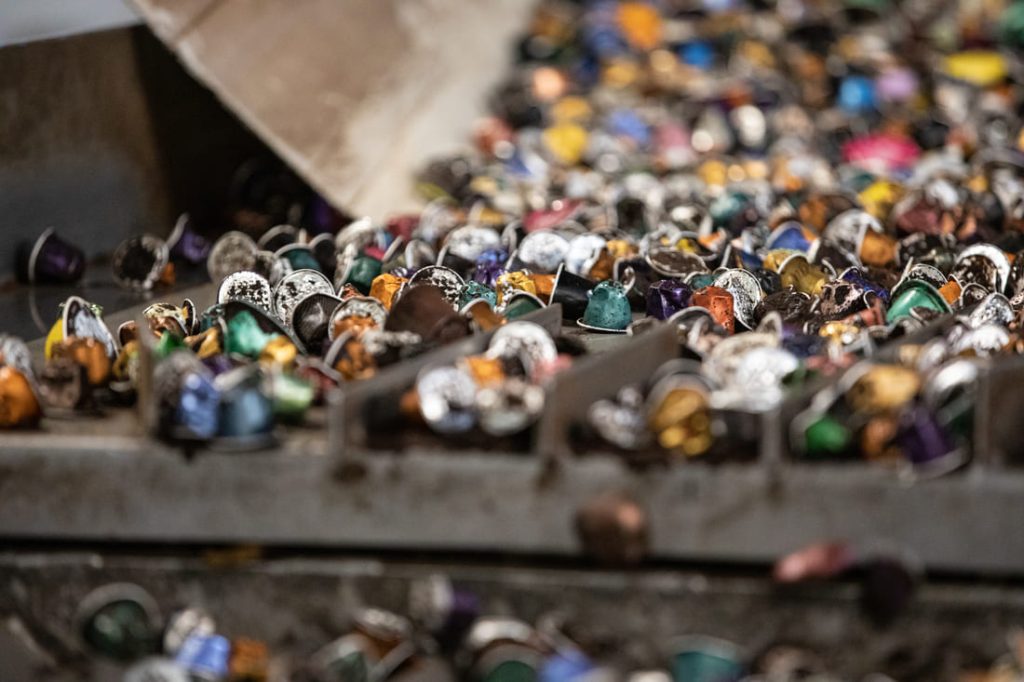
Sustainability is a key component of Nespresso Professional’s corporate responsibility strategy, influencing multiple stages of its operations—from coffee sourcing to the management of materials after use.
Through its free professional capsule recycling program, used capsules are collected so that coffee grounds can be separated from aluminum.
The coffee grounds can be repurposed as natural fertilizer or used for energy production, while the aluminum is recycled and reintroduced into the production cycle as a valuable raw material.
This approach actively supports circular economy principles and contributes to reducing the waste generated every day.
A notable example of coffee waste utilization is the collaboration between Nespresso Professional and the Greek company PHEE.
Through this partnership, coffee grounds are repurposed to create Cophee Board, an innovative material used in professional applications and everyday products.
This initiative demonstrates in practice that what was once considered waste can be transformed into a new raw material with real value.
At the same time, it highlights the opportunities that emerge when innovation meets sustainability and circular economy principles.
The most meaningful changes do not always come from major decisions. Often, they begin with the way a business operates every day.
Proper management of recyclable materials, waste reduction, responsible resource use, and collaboration with organizations that invest in sustainable practices can all contribute to building a more responsible business culture.
Particularly in businesses with high daily coffee consumption, these small actions can create a significant impact over time.
Coffee will continue to be an integral part of the hospitality and foodservice experience. At the same time, the need for more responsible practices is becoming increasingly important.
Coffee waste recycling and the adoption of circular economy practices give businesses the opportunity to reduce their environmental footprint without affecting service quality or day-to-day operations.
Because every cup of coffee leaves behind a footprint. The question is whether that footprint will end up as waste—or become the starting point of a new resource cycle.
That is precisely the essence of the circular economy.
Coffee waste includes used coffee grounds, capsules, and other materials that remain after a coffee beverage has been prepared.
Recycling helps reduce waste, improve resource efficiency, and lower a business’s environmental footprint.
By adopting practices such as recycling, proper waste management, reducing waste, and implementing circular economy principles.
The coffee grounds and aluminum are separated so they can be repurposed in new applications and production processes.
It refers to the practice of recovering and reusing coffee-related materials and by-products to reduce waste and create new value from resources that would otherwise be discarded.